
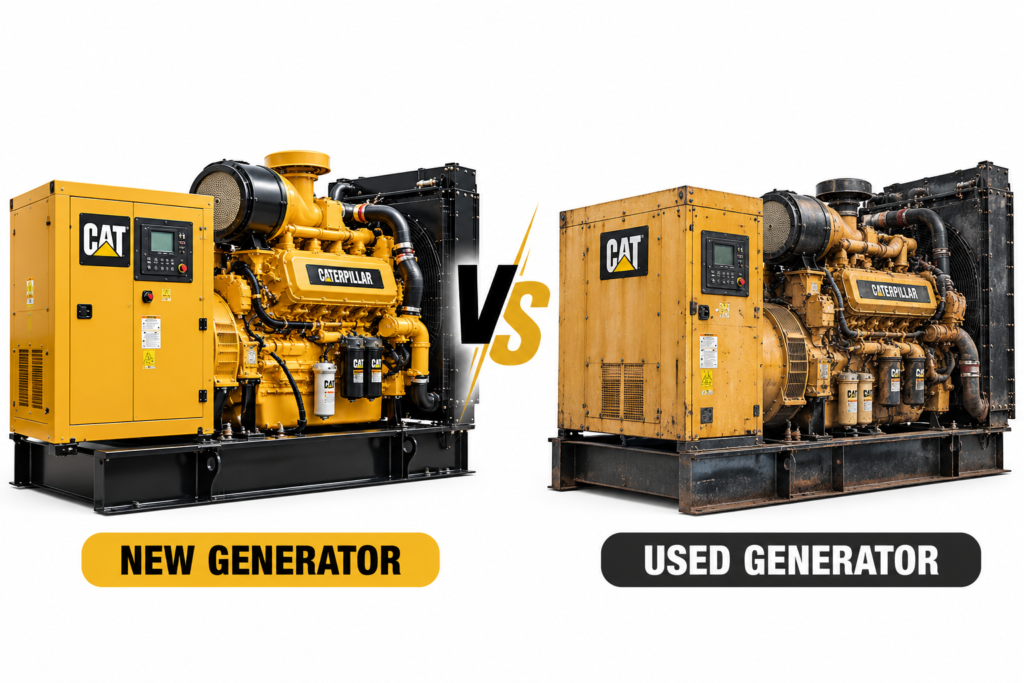
At some point in every industrial generator purchase, you face the same question: do you buy new, or do you buy used? The answer is not the same for every buyer. A hospital expanding its backup power infrastructure has different requirements than a rental fleet operator adding 200kW units to cover short-term demand. A data center developer on a tight timeline has different constraints than a municipality planning five years out.
This guide walks through the real tradeoffs so you can make the right call for your specific application and budget.
The Case for Buying New
Zero Hours, Zero Unknown Risk
A new industrial generator has never been run. Every wear surface, seal, gasket, bearing, and electrical component is at the start of its service life. For applications where the generator is the last line of defense, such as hospitals, data centers, and emergency services, the elimination of prior-use risk has real value. You know exactly what you have.Full Manufacturer Warranty
New generators from major brands come with standard manufacturer warranties, typically 1–5 years depending on the brand and model. Caterpillar’s standard warranty covers 5 years on their industrial generator sets. Cummins offers a 2-year standard warranty with extended options. For a facility that cannot absorb unexpected maintenance costs or downtime, warranty coverage is a meaningful financial protection.Current Emissions Compliance
A new generator built today meets EPA Tier 4 Final emissions requirements, the current standard. Installing a used Tier 2 unit in a jurisdiction that requires Tier 4 Final creates permit risk and potential enforcement exposure. If your site is in California or another state with strict air quality enforcement, a new unit may be your only compliant option.Latest Technology
Modern industrial generators include digital control systems with network connectivity, advanced fault logging, remote monitoring capability, and improved fuel efficiency at partial load. If your facility management team relies on integration with building automation systems, newer control platforms make that easier.The Case for Buying Used
Significant Cost Savings
A verified pre-owned industrial generator in the 100–500kW range typically costs 30–60% less than an equivalent new unit. At a $100,000 price point for a new Caterpillar C15, a load-bank tested pre-owned C15 with 2,000 hours can often be purchased for 45,000–60,000. That 40,000–55,000 savings funds a significant portion of installation, accessories, and maintenance reserves.Availability Now, Not in 16–24 Weeks
This is one of the most underappreciated advantages of the pre-owned market. Current lead times from OEM dealers for new industrial generators run 16–24 weeks depending on the model and configuration. A construction project awarded this month, a data center expansion needed before Q4, or an emergency replacement following equipment failure cannot wait six months. Pre-owned units available in the secondary market can typically be on-site within 1–2 weeks.Proven Performance
A used generator with documented service history and a current load-bank test has a performance record that a new unit in a box does not. You can verify that it produces its rated output under actual electrical load. A well-maintained unit with 3,000 hours has proven its reliability over thousands of hours of field operation.Rental Fleet Applications
For rental companies, buying new generators at full OEM price is difficult to justify financially unless utilization rates are exceptionally high. Pre-owned units at 40–60% of new cost can produce positive ROI at much lower utilization thresholds.The Critical Difference: Verification
The single biggest risk in buying a used generator is buying one without proper verification. This is where the market gets dangerous. A generator that starts and idles is not the same as a generator that performs at rated output under real electrical load. Before any used generator purchase, require all of the following:- Load-bank test: The unit must run at its full rated kW output under a calibrated resistive load bank. Test results should document voltage, frequency, fuel consumption, coolant temperature, and oil pressure at 25%, 50%, 75%, and 100% load. No exceptions.
- Service records: Maintenance history documenting oil changes, coolant service, and major repairs. Gaps in records are a risk signal, not a minor administrative issue.
- Oil and coolant analysis: Lab-tested fluid samples that identify internal wear and contamination invisible to visual inspection.
- Control panel testing: Full functional check of the generator’s control system, including fault logging, automatic start, and voltage and frequency regulation under load.
Side-by-Side Comparison
| Specification | Detail |
| Purchase Price | New: Full MSRP | Used: 30–60% less |
| Lead Time | New: 16–24 weeks | Used: 1–2 weeks typically |
| Warranty | New: Full manufacturer | Used: None (unless included) |
| Emissions | New: Tier 4 Final | Used: Tier 2 or Tier 4 (verify) |
| Performance History | New: Unknown (zero hours) | Used: Documented if verified |
| Depreciation | New: Significant first year | Used: Already depreciated |
| Risk | New: Manufacturing defects only | Used: Prior use risk (mitigated by verification) |
| Best For | New: Mission-critical, regulated, long-term | Used: Budget-sensitive, fast timeline, fleet |
How to Decide
Use these questions to guide your decision:- Is this application mission-critical with no tolerance for downtime risk? If yes, new reduces risk to near zero.
- Does your location require EPA Tier 4 Final emissions compliance? If yes and you cannot obtain an installation permit for Tier 2, buy new.
- Is your timeline less than 8 weeks? If yes, the used market is almost certainly your only viable option.
- Is the application a rental fleet addition, secondary backup, or short-term use? If yes, a verified used unit makes strong financial sense.
- Can you access a load-bank-tested unit with service documentation? If yes, the used risk is substantially mitigated.
Power Trade X Carries Both
We sell new and pre-owned industrial generators across all major brands, including Caterpillar, Cummins, Kohler, Doosan, Generac, and more. Every pre-owned unit we offer has been load-bank tested and inspection-verified. We will give you an honest recommendation for which direction makes sense for your application. Tell us your kW requirement, application, timeline, and budget, and we will find the right unit. Power Trade X: Powering Your Success We buy, sell, consign, and source diesel generators and air compressors nationwide. Call 888-769-3780 or visit powertradex.com.FAQs
- Is it better to buy a new or used industrial diesel generator?
- How long do used industrial generators typically last?
- Why are used industrial generators cheaper than new ones?
- What are the risks of buying a used industrial generator?
- When should a business invest in a new industrial generator instead of a used one?