
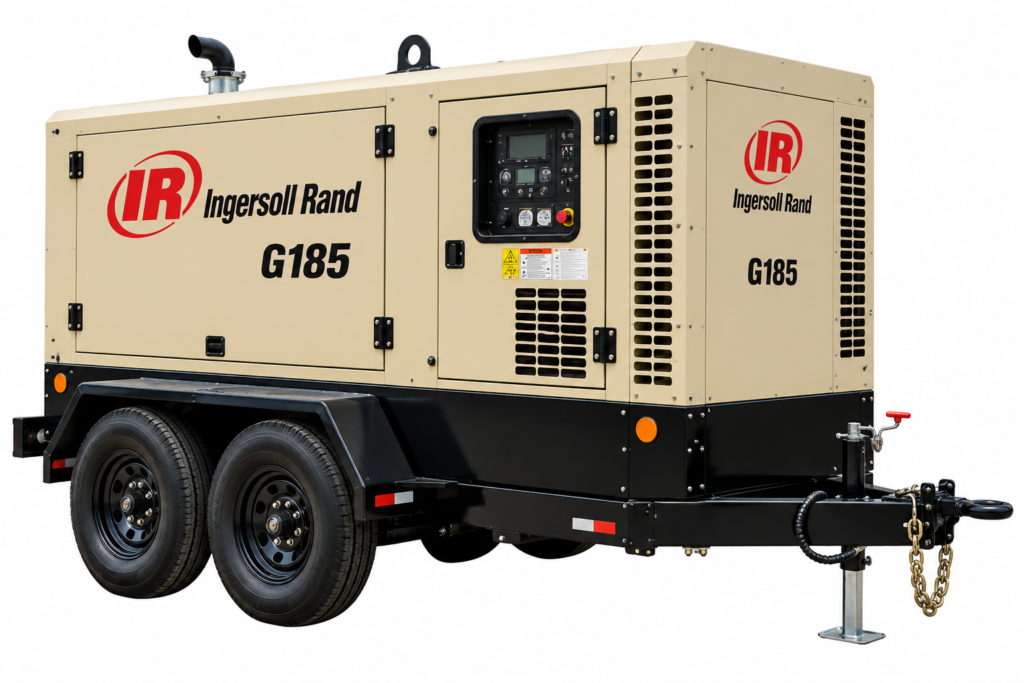
The Ingersoll Rand G185 has been one of the most deployed towable diesel generators in the North American rental and construction market for the past two decades. At 146kW, it sits in the workable range for mid-size construction sites, utility work, events, and applications that need portable power without permanent installation.
Power Trade X currently has multiple Ingersoll Rand G185 units in stock. This guide covers the specs, applications, what to look for when buying used, and current pricing.
The G185 is a road-towable unit with a pintle hitch or ball hitch connection depending on the trailer configuration. It meets standard oversize requirements for road transport on a standard flatbed or fifth-wheel trailer without special permitting in most states.
Power Trade X has Ingersoll Rand G185 units in stock at $24,000 (2008 build, 5,580 hours) and $27,500 (2007 build, 2,950 hours). Both are load-bank tested. Call 888-769-3780 for current availability and condition documentation.
Ingersoll Rand G185 Generator Specifications
| Specification | Detail |
| Brand | Ingersoll Rand (now Doosan / Bobcat Power) |
| Model | G185 |
| Output | 146 kW / 182 kVA |
| Engine | John Deere 6068HF285 Diesel (most common spec) |
| Displacement | 6.8 L, 6-cylinder |
| Emissions | EPA Tier 2 or Tier 3 depending on the year |
| Voltage Options | 480/277V, 208/120V, 3-Phase, 60Hz |
| Fuel Tank | 172 gallon integral |
| Approximate Runtime | ~18–22 hours at 75% load |
| Noise Level | Approximately 68–72 dB(A) at 23 feet |
| Configuration | Sound attenuated, trailer-mounted, road-towable |
| Weight | ~9,500–10,500 lbs depending on the year and options |
| Control Panel | Digital with auto-start capability |
Why the G185 Has Stayed in Rental Fleets for 20 Years
The G185’s longevity in rental inventories is not an accident. It hits a practical power class. At 146kW, it is enough for a substantial mid-size construction site or a commercial building’s temporary power requirement, while remaining light enough and compact enough to transport efficiently. John Deere’s 6.8L diesel engine is one of the most widely serviced diesel platforms in North America. Every Cat dealer, every John Deere dealer, and most independent diesel shops can service the engine. Parts availability is a non-issue in virtually any location where construction work happens. That serviceability factor is the reason rental companies kept buying them, and the reason used units continue to sell.Common Applications
Construction Sites
The G185 is a standard piece of equipment on mid-size commercial and residential construction projects. It powers tool trailers, temporary lighting systems, crew accommodations, and construction equipment with onboard electrical demands. Its towability means it moves with the project rather than requiring a crane or specialized rigging to relocate.Utility and Infrastructure Work
Road resurfacing, utility line work, and municipal infrastructure projects commonly run G185 units. The 172-gallon fuel tank provides enough runtime that a crew can work a full shift and overnight without a fuel truck visit.Emergency and Storm Response
Hurricane and disaster response operations use G185 units extensively because they can be staged and deployed without specialized equipment. A pickup truck with a proper hitch can move a G185. In post-storm environments where heavy crane equipment is not available, this matters.Events and Film Production
Large outdoor events and film production companies use G185 units as primary power sources for remote locations. The sound attenuation keeps operational noise manageable, and 146kW handles substantial lighting and electrical production loads.Used G185 Generator Pricing
Current market pricing for used Ingersoll Rand G185 generators:| Specification | Detail |
| Under 2,000 hours | 28,000–40,000 |
| 2,000–4,000 hours | 20,000–32,000 |
| 4,000–6,000 hours | 15,000–25,000 |
| Over 6,000 hours | 10,000–18,000 (service history critical) |
What to Inspect on a Used G185
Trailer Frame and Running Gear
G185 units see significant road miles over their service lives. Inspect the trailer frame for cracks, particularly around the tongue and axle mounting points. Check tire condition, bearing play in the wheels, and the hitch connection for wear. A generator with an excellent engine can be a liability if the trailer frame is compromised.Engine Hours vs. Condition
Hours alone do not tell the complete story. A G185 with 6,000 hours from a rental fleet with disciplined oil change intervals and coolant maintenance can be in better operating condition than one with 2,000 hours from an operation that ran it hard and skipped service. Ask for records. If no records are available, oil analysis becomes essential.Load-Bank Test
Run the unit under a load bank at its rated 146kW output. The G185 should maintain 480V (or selected voltage) within 2–3% and 60Hz within 0.5Hz under steady-state load at 75% and 100%. Instability in voltage or frequency under load indicates alternator issues or engine governor problems.Fuel System
Check the 172-gallon fuel tank for water contamination, a common issue on units that sat for extended periods. Drain a sample from the tank drain valve and inspect for water separation. Replace the fuel filters before putting any used G185 into service, regardless of condition.Sound Attenuation
Inspect the acoustic panels and door seals. Damaged insulation or missing panel sections increase operational noise and indicate the unit has been used hard or stored improperly. Replacement panels are available but add cost.G185 vs. G145: What’s the Difference?
Ingersoll Rand also produces the G145 in the same towable platform, rated at 115kW. The G145 uses the same trailer and similar packaging, but the smaller engine and lower output make it appropriate for applications where 146kW is more than needed. For buyers where cost is the primary constraint and 115kW is sufficient, the G145 is typically 3,000–6,000 less than a comparable G185. Power Trade X: Powering Your Success We buy, sell, consign, and source diesel generators and air compressors nationwide. Call 888-769-3780 or visit powertradex.com.FAQs
- How much does a used Ingersoll Rand G185 generator cost?
- Is the Ingersoll Rand G185 powerful enough for a construction site?
- How long can an Ingersoll Rand G185 run on a full tank of diesel?
- What should I look for when buying a used Ingersoll Rand G185 generator?
- What is the difference between the Ingersoll Rand G185 and G145 generators?