
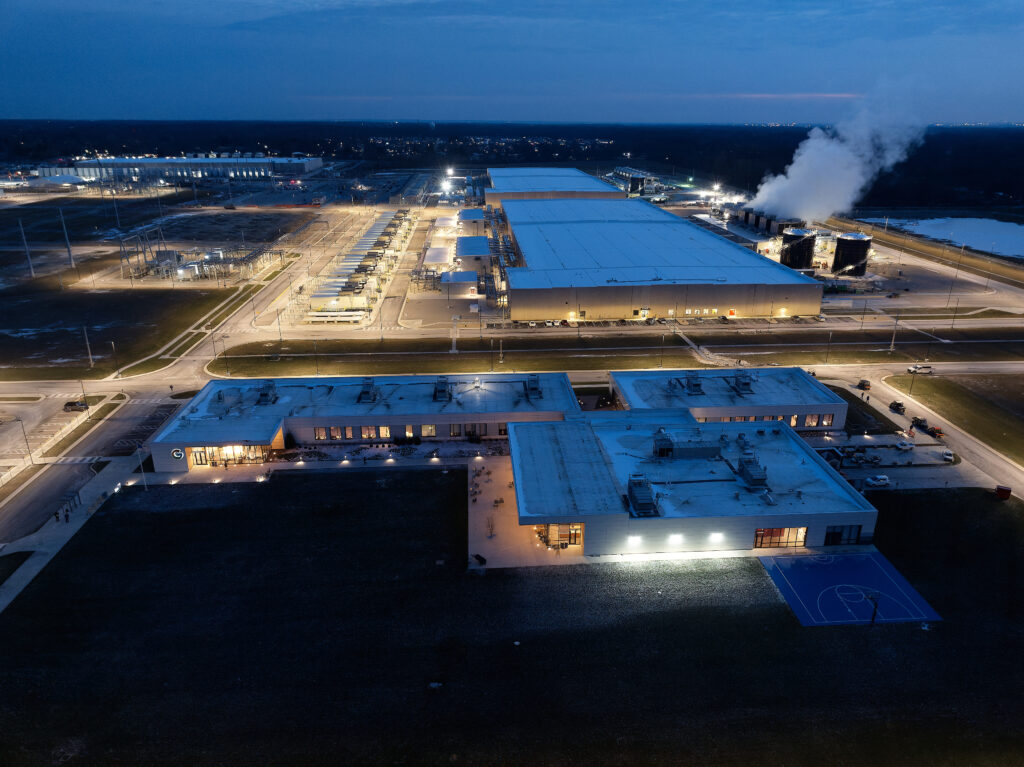
Data centers used to be back-room utilities supporting email and websites. Today they’re the industrial engines of the digital economy — powering cloud services, AI training farms, streaming, fintech, and more. That growth has a simple, uncomfortable consequence: data centers are one of the fastest-growing electricity consumers in the United States, and they’re forcing a rethink of how resilience, capacity, and carbon goals are balanced. Generators — long treated as “backup only” — are now central to that rethink.
The Scale of the Problem
U.S. data centers consumed roughly 176 TWh of electricity in 2023 — about 4.4% of national demand — and forecasts show that number climbing toward 6–12% by 2028. Record load growth, cluster build-outs, and AI-driven compute are pushing utilities and grid operators to re-evaluate capacity planning. Modern hyperscale campuses can draw as much power as small cities. When these facilities multiply rapidly within a region, the grid, fuel supply chain, and local infrastructure feel the strain.Why Generators Matter More Than Ever
Generators in data centers were once simple safeguards. Today, they’re part of proactive energy strategy due to:1. Massive AI and hyperscale power demand
AI training and inference clusters require dense power and ultra-high uptime. Utility delays mean operators lean on on-site generation to meet timelines.2. Grid connection bottlenecks
New substations and transmission lines can take years. Natural-gas gensets and modular generator plants allow facilities to move forward while waiting on long interconnection queues.3. Cleaner, more capable generator technologies
Natural gas, biogas-capable gensets, modular power blocks, and generator-plus-battery hybrid systems are redefining resilience while helping reduce emissions.Generator Types and Tradeoffs
Diesel Generators – Fast-start, reliable, industry standard for emergency backup. Challenges: emissions, fuel logistics, permitting. Natural Gas Generators – Lower emissions, long continuous runtime, growing as a prime-power choice. Biogas/RNG-Compatible Units – Reduced lifecycle carbon where renewable gas is available. Hybrid Solutions – Gensets paired with large-scale BESS, solar, or CHP to reduce runtime and carbon footprint. Modular/Containerized Gensets – Rapid deployment, scalable, ideal for data-center expansions or edge sites.Backup vs. Prime vs. Clean-Firm
- Backup-only: Traditional emergency standby.
- Prime/Continuous: Used when grid capacity is unavailable or constrained.
- Clean-firm hybrid: Batteries + fuels + on-site renewable or low-carbon sources: the emerging model for sustainable, high-uptime campuses.
Design and Resilience Considerations
- Redundancy model (N, N+1, 2N)
- Fuel supply and storage strategy
- Emissions controls and environmental permitting
- Integration with UPS, BESS, and renewable assets
- Modular scalability for rapid growth
Sustainability and Community Impact
Data-center expansion is prompting scrutiny of emissions, noise, water use, and grid reliance. Operators are responding with emissions controls, cleaner fuels, better monitoring, and investment in microgrids and hybrid power strategies.The Future: More Power, Smarter Power
Expect continued growth in:- On-site generation and microgrids for faster deployment.
- Flexible energy strategies involving demand response, storage, and dual-fuel technologies.
- Hybrid power architectures that integrate generators, batteries, and renewable systems.