
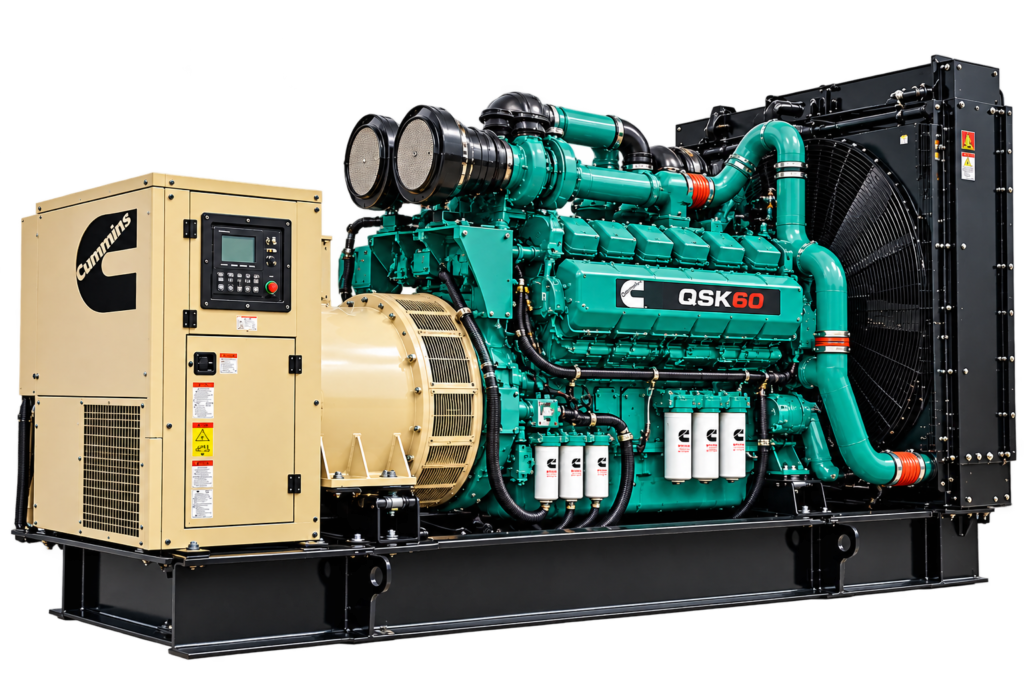
The Cummins QSK60 is a high-displacement diesel engine that powers some of the largest generator sets in the pre-owned industrial market. At ratings between 1,500kW and 2,500kW depending on the generator set configuration, QSK60-powered units serve data centers, large industrial facilities, utility applications, and mining operations where a single generator needs to carry a substantial load.
If you are in the market for a used QSK60 generator set, this guide covers exactly what you are buying, what to inspect, and what to expect to pay.
The QSK60 Engine: What Makes It Different
The QSK60 is a 60-liter, V-16 diesel engine. Cummins developed it specifically for demanding applications where lower-displacement engines hit their limits. The “Q” in QSK stands for “Quantum”, Cummins’ designation for their high-performance, high-efficiency engine series. The “SK” refers to the aftercooling and turbocharging configuration that allows the engine to produce high output at comparatively lower fuel burn rates than older high-horsepower platforms. In generator set applications, QSK60 engines are mated to high-quality alternator ends, such as Stamford, Kato, and Leroy Somer, which are the most common, and packaged inside containerized or open-skid frames sized for the output class.Cummins QSK60 Generator Specifications
| Specification | Detail |
| Engine | Cummins QSK60-G (various G-series variants) |
| Displacement | 60 L (3,661 cu in), V-16 |
| Standby Output | 1,500–2,500 kW (varies by generator set model) |
| Common Generator Models | DQKAN, DQKAF, and C-series variants |
| Voltage | 480V, 4160V, 13,800V, 3-Phase, 60Hz (varies by application) |
| Rated Speed | 1800 RPM |
| Cooling | Separate circuit cooling system standard |
| Emissions | EPA Tier 2 (most pre-owned units) |
| Typical Alternator | Stamford HCM634, Kato, or Leroy Somer equivalent |
| Fuel Consumption | ~120–160 gal/hr at 100% load depending on kW rating |
Who Buys Used QSK60 Generators
The QSK60 market is not a consumer market. Buyers are facilities managers, data center operators, industrial plant engineers, utility contractors, and mining companies. A unit in this power class is infrastructure. The decision involves engineering review, site preparation, and integration into existing power systems.- Data centers: A 1,500–2,000kW generator covers the backup power requirement for medium to large data center pods. N+1 configurations place multiple QSK60 units in parallel, one for every active unit, with one spare.
- Industrial plants: Process-critical manufacturing operations, chemical plants, and heavy industrial facilities use QSK60-class generators for prime or peak-shaving applications where grid reliability does not meet operational requirements.
- Utilities and municipalities: Water treatment facilities, pumping stations, and emergency management agencies source QSK60 units for critical infrastructure backup.
- Mining operations: Remote mine sites in areas without grid access run QSK60 generators as primary power sources for the duration of the operation.
Used QSK60 Generator Pricing
Pre-owned QSK60 generator sets move in a wide price range depending on hours, configuration, voltage, and whether the unit was in service as standby or prime power:- Under 500 hours: 250,000–500,000 depending on kW and voltage configuration
- 500–2,000 hours: 150,000–300,000
- 2,000–5,000 hours: 80,000–180,000
- High-hour units: Negotiated based on overhaul need
Inspection Checklist for a Used QSK60
A QSK60 purchase at this price level requires proper due diligence before any offer is made. Do not accept a seller’s verbal description as sufficient evidence of condition.1. Load-Bank Test
This is non-negotiable. The unit must run under a calibrated load bank at its rated kW output, not a partial load or a no-load run. Demand a load test report showing voltage, frequency, fuel consumption, coolant temperature, and oil pressure at 25%, 50%, 75%, and 100% load steps. A seller unwilling to load-bank test a unit has something to hide.2. Oil and Coolant Analysis
Send oil and coolant samples to an independent lab before purchase. Oil analysis identifies metal particulates that indicate bearing wear, ring wear, or liner damage that no visual inspection catches. Coolant analysis identifies combustion gas intrusion (head gasket failure) and electrolytic corrosion. These tests cost under $100 and protect a six-figure purchase.3. Hours Verification
Confirm hours on the digital control panel against any available maintenance records. If the hours do not align or records are sparse, adjust your offer accordingly. Request an Echelon report from the Cummins dealer network if available. Cummins logs service events electronically for registered units.4. Alternator Condition
Check winding insulation resistance (megohm test). A reading below 1 megohm on any phase indicates moisture ingress or insulation breakdown. Rewind costs on a QSK60-class alternator run 20,000–60,000. Factor this into any offer on a unit with questionable alternator condition.5. Emissions Compliance
Most pre-owned QSK60 units are EPA Tier 2. If your installation location has Tier 4 Final requirements, particularly in California or in certain jurisdictions under permit, a Tier 2 unit may require an emissions waiver or may not be installable at all. Confirm before buying.Where to Find Used QSK60 Generators
The used QSK60 market is thin. Units in this power class are not commodities. They sell through specialist industrial equipment brokers, directly from data center decommissions, and from rental fleet liquidations. Power Trade X sources, inspects, and brokers QSK60-class generator sets for buyers across North America. If you have a specific kW requirement, voltage, and timeline, contact our team has the details, and we will locate units that meet your specifications. We also purchase QSK60 units directly from owners looking to liquidate. Power Trade X: Powering Your Success We buy, sell, consign, and source diesel generators and air compressors nationwide. Call 888-769-3780 or visit powertradex.com.FAQs
- How much does a used Cummins QSK60 generator cost?
- How many kW does a Cummins QSK60 generator produce?
- Is buying a used Cummins QSK60 generator worth it?
- How much fuel does a Cummins QSK60 generator consume per hour?
- What should I check before buying a used Cummins QSK60 generator?